
Learning cycles are at the heart of the Human Learning Systems (HLS) approach to organising and governing public service, offering a structured yet flexible way to make sense of complex work, generate insights, innovate and improve practice. They are also core to how we at Collaborate help organisations to work in complexity.
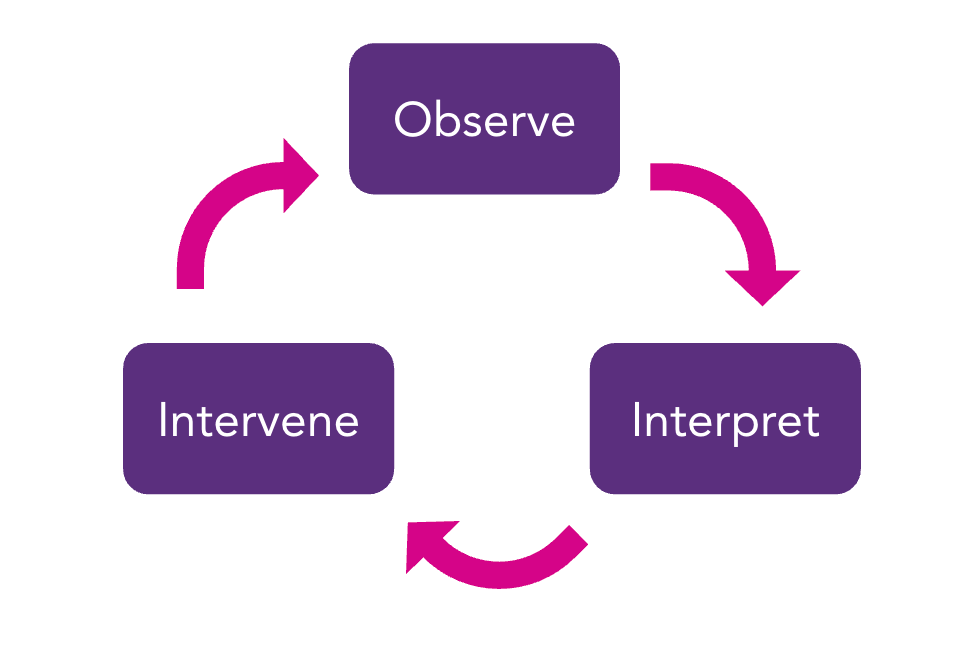
Learning cycles help to shift us from target driven delivery towards constant experimentation, iterating the interventions we make based on what is actually happening in the work – whether that be in the relationship between a practitioner and a citizen, or across a whole service or system.
At its simplest, a learning cycle follows a clear learning rhythm – observe what’s happening, make sense of it together, and test new ways of working before embedding what you learn.
In HLS, this takes shape through four interconnected phases: creating shared purpose, understanding the system and the relationships within it, co-designing experiments or explorations, and finally embedding and influencing practice or system conditions based on what emerges. This provides just enough structure to guide collective learning while remaining flexible enough to adapt to the realities of complex work.
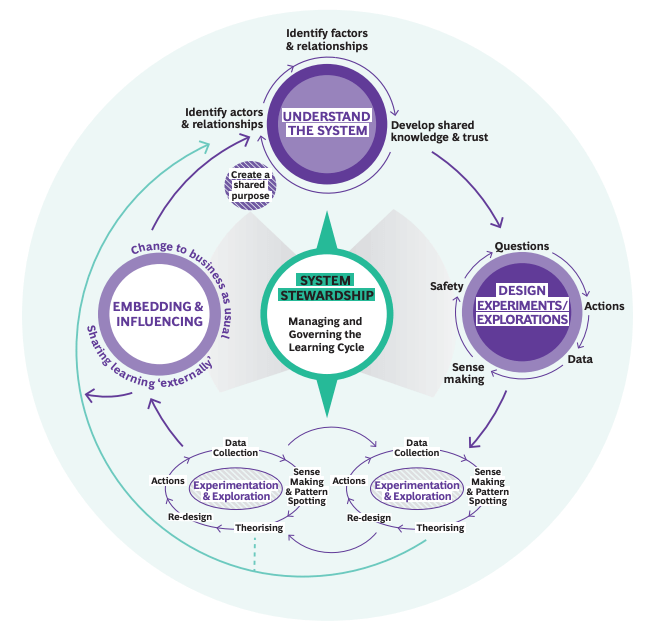
What makes learning cycles work in practice is to treat them as fluid and adaptive, rather than as a rigid process. As Human Learning Systems: A Practical Guide for the Curious puts it
“The Learning Cycle that you plan will not be the learning cycle that you end up running… The messy difference between your plan for a learning cycle and how it actually operates in practice reflects the reality of working in complex systems. Don’t let fear of the mess prevent you from starting. You cannot plan, and then undertake, the ‘perfect’ Learning Cycle, so don’t become paralysed with worry about whether your plan is perfect.”
In September 2025 we ran a lively, practical session exploring how learning cycles can support meaningful learning and improvement. We spoke with practitioners we have been supporting to develop learning approaches – Jill Cornforth from Ideas Fund, Emyr Williams from Social Care Wales and Dan Jacques from Barnwood Trust Gloucestershire Short Breaks Partnership, along with our colleague Amy Hurst – each influenced by HLS principles to carve out learning cycles in their own ways. For Jill and Emyr it’s about learning from the work they are involved in. For Dan and Amy it’s about using learning cycles to innovate and design a new service.
What unites them is a commitment to learning from their interventions into complex systems and using those insights to improve their work or influence broader change. In practice, this involves navigating who is involved, planning the processes and structures that support learning, understanding the rhythms and timelines of cycles, and deciding how insights are surfaced, documented, and shared.
Framing learning cycles
So, what makes a learning Cycle different from standard evaluation or project reporting? Simply put, it’s about intentionally making space to notice, reflect, and act collectively, in a structured, cyclical process.
For those new to learning cycles, practitioners emphasised starting small and iterative: identifying the learning questions, considering who holds relevant knowledge, and creating a safe space for dialogue. Early cycles may feel experimental and imperfect. Reflecting on the complexity of working in systems with multiple perspectives and competing priorities, Jill highlighted this experimental nature: “Sometimes the bravery is to do it once and figure out how you did it badly and then shape it for the next time.”
Practitioners emphasised that each cycle is an opportunity to notice, reflect, and act collectively in a structured, iterative way, even when the topic or intervention is huge.
Jill reflected on the Ideas Fund experience:
“For us, a lot of the themes, a lot of the topics that we’re diving into are potentially quite huge ones. So our second learning cycle has been all around what happens when you completely reconsider what research even is, and that is so big and so broad {[… ]and having to hold that tension between feeling like you have said enough and being realistic with the fact that essentially all you’re able to do is reflect some of the things that you’ve heard this time…”.
This illustrates a central principle: a learning cycle cannot capture absolutely everything, but can provide a way to intentionally reflect on one part of the work and build on it over subsequent cycles, shaping the next steps and allowing teams to adapt over time.
Navigating challenges and difference
Running learning cycles is not without challenges. Time constraints, competing priorities, and the complexity of multi-partner collaborations can make it difficult to keep cycles meaningful and consistent. Dan from Barnwood Trust reflecting on his role as an independent funder, spoke about balancing innovation with practical constraints:
“So it’s it’s for us it’s been how can we get that big array of views into the room and not advocate for one approach being better for the other and try to get everybody…bending a little bit, so that the thing we have in the middle is the best of of what we can do in terms of compromise. Once we get into live conversations during procurement those conversations will be more acute.”
This highlighted a recurring challenge in learning cycles: managing contention, diverse perspectives, and power dynamics while maintaining momentum and collective focus. Participants noted these challenges are not roadblocks, but integral to the learning process, negotiating difference, holding tension, and iteratively reflecting on feedback are central to the methodology.
Key conditions for effective learning cycles
Drawing on both our conversations with practitioners and our wider experience at Collaborate, several consistent themes emerged as essential for learning cycles to work well.
Time and space
Meaningful reflection happens when time is intentionally protected. Practitioners emphasised that creating space for meetings, reflection, and preparation is a worthwhile investment that strengthens the quality of learning, especially when supported by good coordination and scheduling. This protected time enables deeper insights and allows the emergent nature of the cycles to flourish.
Trust and relationships
Learning Cycles rely on honest dialogue, which requires trust. Clarifying the purpose of sharing learning, whether it’s for immediate action or purely for reflection, was cited as critical. Practitioners noted that creating a safe space for dialogue, where people could share challenges without fear, was transformative.
Organisational support
Learning cycles require more than individual commitment; they depend on deliberate, structural support. This includes senior buy-in, appropriate resourcing, and recognition that reflection is part of the work, not an optional extra. It also means having structured, intentional approaches that enable insight to be shared, connected, and acted on across different parts of organisations and wider systems. As Jill put it, “to recognise it not as a distraction from the work, but is the work”.
Culture of learning
Perhaps most importantly, learning cycles require a culture where reflection is normalised and learning is valued as a management strategy. Rather than seeing reflection as a sign of failure, it’s reframed as essential to improvement. As Emyr shared, “It’s not about failure or things not working, it’s what you can learn from what you’ve done well, from what hasn’t worked so well…and what could we try to improve things”.
Looking forward
A recurring theme from the session was that learning cycles are as much about culture change as they are about improving services. By creating intentional spaces for reflection, dialogue, and shared sense-making, teams are not only generating insights – they are building the conditions for ongoing learning and improvement.
Participants emphasised the iterative nature of learning cycles, noting that their value is amplified over time: insights from one cycle feed into the next, and each cycle strengthens relationships, trust, and capacity for collaboration.
Learning cycles are a practical, relational, and iterative approach to navigating complexity. They require time, trust, and organisational support, but the benefits are substantial: improved practice, stronger partnerships, and a culture of collective learning. As these reflections illustrate, learning cycles are more than a tool, they are a way of working, thinking, and collaborating that helps teams and systems learn together, adapt, and create meaningful change.
Supporting organisations to design, set up and run learning cycles in complexity is central to all our work Collaborate. To find out more about how we can help, take a look at our learning offer page.