
Five pioneering councils have teamed up with Collaborate CIC to share insight, solve
problems collectively and build their influence – all with a common goal: to work with
people, not impose solutions on them.
A version of this article was originally published in The MJ on 11 December, alongside a companion case study from Sheffield City Council.
When no single organisation can see or control the whole system, it takes collaborative leadership, rather than command and control to support places to thrive. Many local authorities are stepping into this role and acting not only as service delivery organisations but also as ‘conveners of place’.
Over the last three months, we’ve brought together a group of Councils working to do just that in our people, purpose, power learning community. Leaders from London Borough of Camden, Doncaster Council, Sheffield City Council, Test Valley Borough Council and Wigan Council have been sharing insight, collectively problem solving and building collective influence. These pioneer places we’re working with have been reflecting on the shared learning and thinking they’ve brought to the complex challenges of local government today.
Whether it’s tackling health inequalities, supporting inclusive growth or increasing community cohesion, our learning community councils tell us that only by collaborating across organisations and with communities can we all achieve real impact.
The Devolution and Community Empowerment Bill offers a particular opportunity for councils to step into and strengthen their role as convenors of place – putting communities at the centre of neighbourhood governance, embracing new powers and responsibilities, and building the new operating model of local government through local government reorganisation. Testing pooled public service budgets in local areas with mean councils will have an increasingly important enabling role to play in helping local partners work better together and embed prevention. This is not just a technical, financial and governance task, but one requiring shared purpose, strong relationships, and a collaborative culture at all levels.
The role of convener is to support and enable collective work, rather than act unilaterally and paternalistically on behalf of the wider system. Not controlling and directing. But instead, enabling a collective conversation, listening and responding in different ways – sometimes leaning in, sometimes stepping back to make space for others, and sometimes taking on a different role like hosting and coordinating.
Creating the conditions to work with people rather than do to them. This means thinking differently about people, purpose and power.
People
For Test Valley Borough Council, developing a person-centred approach and their convening role has gone hand in hand. They bring together a wide range of people across the Borough to work together on their priority issues. From senior leaders to bin operatives to elected members, people working at all levels of the organisation have been on the journey to re-imagine what they do to ‘work with’ people, rather than ‘deliver to’ them. Real change in communities’ and partners’ experience of the council requires a deep focus on organisational development and the internal conditions needed to enable a different approach.
Purpose
Fostering shared purpose is a key role for councils acting as convenors. Wigan’s two Progress with Unity missions set out collective ambitions for the whole borough, marking the council’s shift into a cross-system convening role focused on tackling complex systemic issues. Doncaster’s Great 8 serve a similar purpose, with each priority having a community representative bringing their experience and connecting with others from the voluntary and community sector. With shared purpose, organisations can shift focus from their own delivery to exploring their collective resources and strengths – and those of the community – to achieve shared outcomes.
Collective purpose needs infrastructure and culture that supports collaboration. Traditional partnership boards are unlikely to do the job so places are experimenting with new approaches such as Sheffield’s emerging Partnerships Lab. Councils can contribute by modelling collaborative behaviours, internally and externally, both when it’s easy and – most importantly – when it’s hard.
Power
Shifting to a convening role means having the will and ability to share power. Camden Council see this as requiring local authorities and their staff to be open to taking a deep look at themselves, and to ‘hold their position lightly’. This can mean working transparently in the open, even on really tricky issues, and being prepared to make more space for other voices. In developing their new Progress with Unity strategy, Wigan Council explicitly worked to shift power. They created a new Community Connection Group, as part of an 18 month engagement process, enabling voluntary and community leaders to play a key role in developing priorities and collective ways of working that sit at the heart of the strategy.
Taking on a new role and navigating these shifts is challenging – especially as it often requires rethinking what good looks like and being increasingly comfortable with uncertainty. This isn’t something you do some of the time for specific priorities or plans, but a new way of being. And it takes investment in the time and space necessary to develop trust.
The palpable energy in our learning community sessions suggest these challenges are well worth grappling with. For the authorities stepping into this convening role, the rewards have been clear: enabling more innovative service solutions, stronger relationships, and better meeting residents’ ambitions and priorities. As well as more empowered, motivated staff who are developing new skills and feel more connected to real impact in the places they serve.
Being a convener can be a daunting task – it touches on all parts and functions of a local authority and requires personal as well as organisational change. There’s no single blueprint to follow, and every place will do things differently. But with practical insight from places already on the journey, and the right tools, experience and support to build effective and sustainable collaborations, the opportunity is there for the taking.
The advice from our learning community is clear: start somewhere. Don’t overthink the strategy, but do invest in relationships and be prepared to experiment, learn and adapt as you go.
Ellen Care is Head of Practice at Collaborate and you can contact her to find out more about this work: [email protected]
Read more about our learning community and its background: Learning together: What does it take to embed community power and place-based collaboration at the heart of local government?
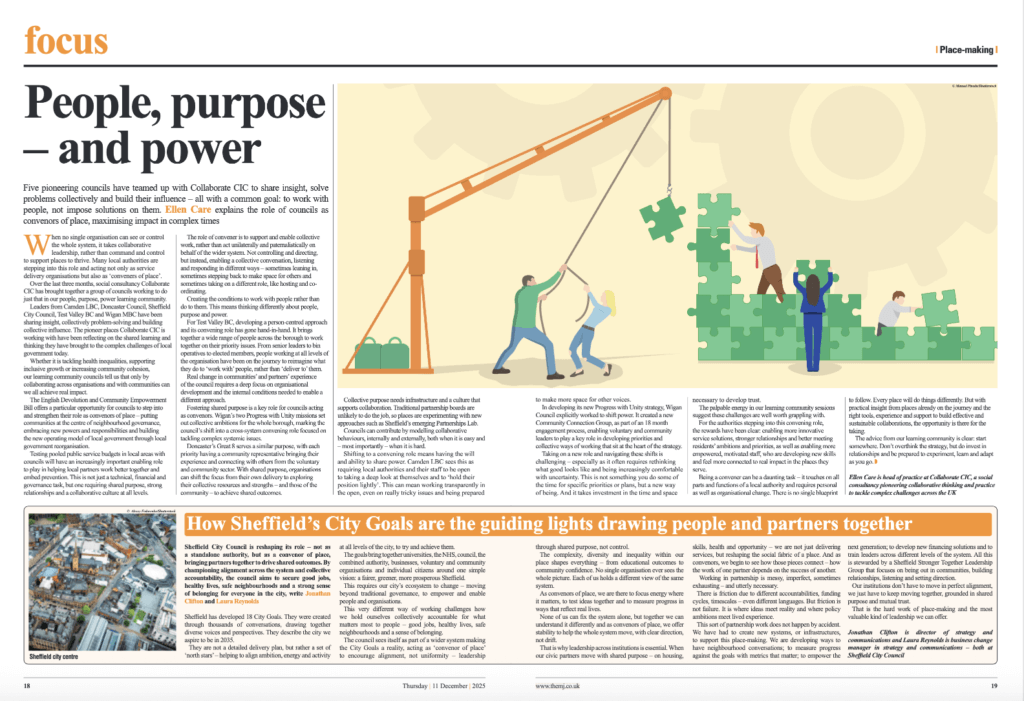
Click on the image above to see a larger version of the original print article.