
How VCSE providers are innovating to bring Short Breaks to more disabled young people in Gloucestershire than ever before.
One year ago, we started our role as learning and evaluation partner to the Gloucestershire Short Breaks Partnership: a collaboration between Barnwood Trust, Gloucestershire County Council Children’s Services and Gloucestershire VCSE Alliance. A year on, we are sharing what we’ve learned from a Test and Learn fund and a Community of Practice of Short Break providers, about what makes a great Short Break, and how providers are breaking barriers to bring Short Breaks to more young people in Gloucestershire than ever before.
We are also sharing how this learning is helping Gloucestershire County Council to recommission Short Breaks through this The work is collaborative, brave and enlightening; it is drawing attention to the real, often invisible, costs and work involved in creating spaces and activities that are genuinely inclusive and accessible to disabled children, young people and young adults. It is pointing to important design principles in shaping and commissioning such provision.
If you don’t have a disabled family member, you may not know about the statutory entitlement that families with a disabled child or young person have to a Short Break, sometimes described as respite care. In this Partnership, we have been using the language of ‘Short Breaks’ and so will continue to do so in this blog.
A ‘Short Break’ offers specialist and appropriate activities, care and support to families of disabled children so that:
- Unpaid carers receive breaks from their caring responsibilities to maintain their resilience, and their physical and emotional wellbeing.
- Disabled children, young people and young adults have opportunities to socialise independently in an environment that is safe, enjoyable and suitable for their needs.
Research by Barnwood Trust in 2022 showed that many families in Gloucestershire could not access a Short Break that met their needs (for example, they couldn’t leave their child at the activity). Researchers found that it was often difficult to find information on what was available, a lack of available and accessible transport was a major barrier, as was a need for more specialist staff training. There were also ‘cold spots’ in parts of the county, where there was limited or no provision.
Barnwood Trust are a charity who believe in using their money to create change for disabled people. And so, they decided to create a Short Breaks fund, with the intention of learning about how Short Breaks could be designed and delivered differently; to overcome the barriers they identified in the research. Alongside a panel of parent-carers and disabled young people, they selected 6 VCSE organisations through a competitive process and funded them for one year to test different approaches, and to share their learning in a community of practice. The aim of this first year was proof of concept and the learning was significant. Armed with new insight, Barnwood invited GCC to see the work in action by attending a Community of Practice session. This proved to be the catalyst and in June 2024, commissioners approached Barnwood and invited them to form a Short Breaks learning partnership. The partnership, which also involves the VCSE Alliance was formed later that year with this vision:
We want Gloucestershire to be a great place to grow up where children and young people thrive and live lives of choice and opportunity. This will be achieved, in part, through best practice progressive and relational commissioning and funding so that families of disabled children and young people have a voice and choice in the services that exist for them.
One of the immediate outcomes was that Barnwood and GCC agreed to match-fund a further two years of test and lean work, focussing on two ‘cold spots’ – one urban and one rural. At the same time, Barnwood agreed to continue to fund all the initial projects and GCC extended their commissioned contracts for the duration of the Partnership.
Overall, the Partnership brings £2.5million in funding for Short Breaks in Gloucestershire. The four existing GCC commissioned providers were also brought into the Community of Practice (CoP). In April 2025, Year One of the new Test and Learn (T&L) programme kicked off and Collaborate were appointed as evaluate and learning partner.
The Short Breaks on offer across this network are rich and varied: they include sensory, social, creative, nature-based and sports activities. They are aimed at variously parents with under-8’s, primary age, teenagers and young adults. Some are regular weekly activities, some are holiday schemes, or after-school clubs. Some are school based, whilst most are based in and/or use different community, outdoor and commercial venues. Some providers specialise in neurodivergent conditions; others cater particularly for children with physical and/or learning needs. Some encourage parents to stay and take part, or to network in a separate space. Others are very much about giving parents a real break – leaving their child to have fun in a safe and trusted environment. It turns out that this variety is essential.
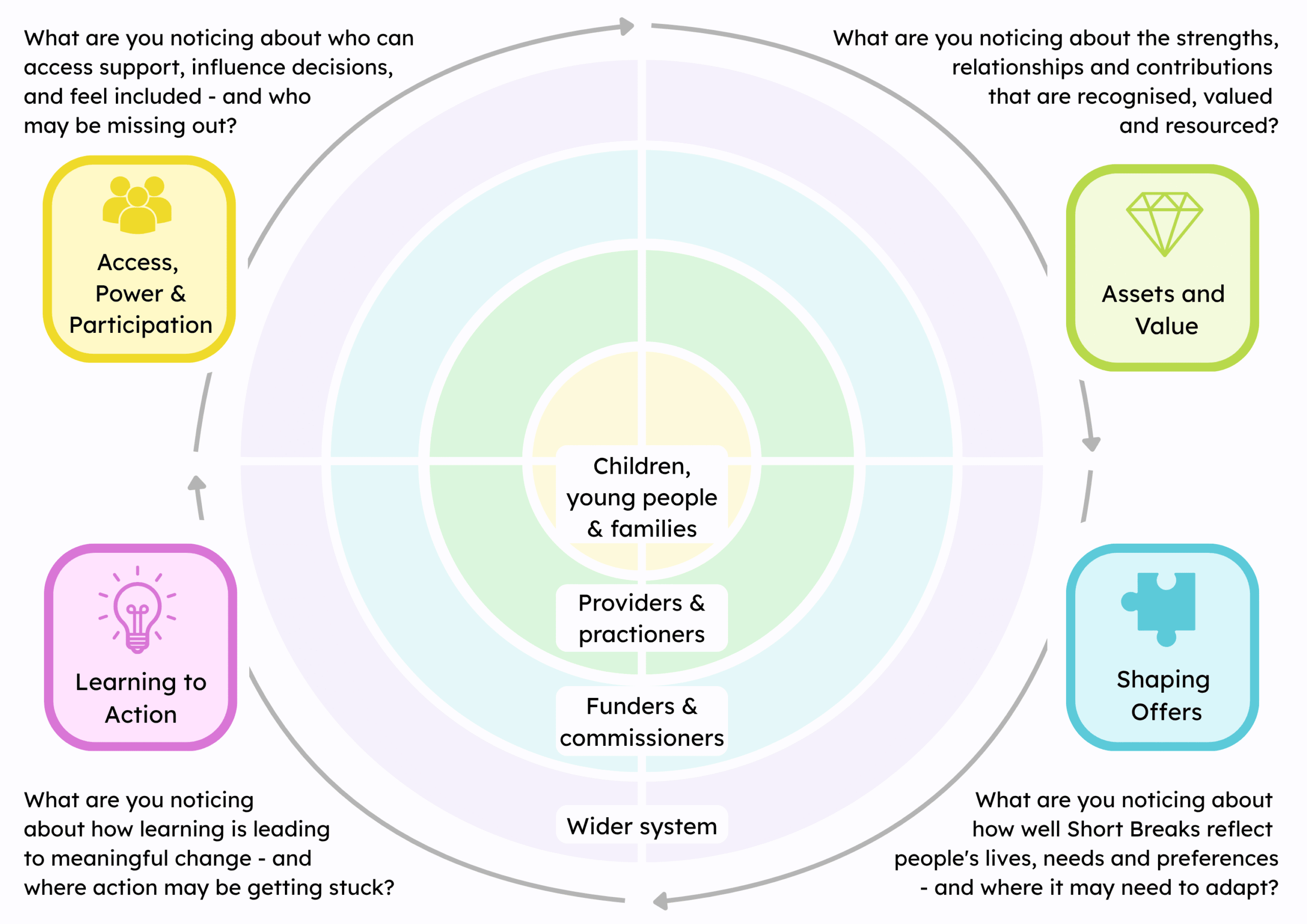
The CoP, which includes 12 VCSE providers, meets every six weeks. Providers also give their time to us in interviews and visits. Working with the COP we designed a learning framework to help us make sense of the many insights coming from the work. The framework is dynamic, and systemic. This means it is helping us move through the process of design, delivery and sensemaking from the pilots – and influencing what comes next. It looks at the work through four lenses – children, young people and families, the providers, the funders and commissioners, and the wider system which interacts with the families accessing Short Breaks.
The T&L providers have also recently submitted their first annual reports – providing more rich insight into their work, its outcomes and the pathways to impact. Short Breaks this past year have:
- Been attended by more than 1000 individual young people aged 4 to 25.
- 66% of them were reported to be new to Short Breaks.
- Roughly 500 sessions were delivered in total. Sessions range from 1.5 to 24 hours – with an average of 3-hours per session.
- Between 1 and 50 young people attended each session.
- 1200 young people and families were involved in designing Short Breaks.
Proof of how our child can thrive in the right environment.
Parent-carer
Short Breaks have:
- Increased children/young people’s confidence, participation and emotional regulation, with many excited to attend and feeling safe and accepted.
- Built friendships and peer networks (including older young people acting as role models) and reduced isolation through consistent, SEND-aware environments.
- Provided meaningful breaks for parent‑carers (time with siblings, reduced burnout, and supported ways to reconnect through facilitated play).
- Reached families new to Short Breaks, including those previously excluded or without formal diagnosis, supported by neuro‑affirmative/trauma‑informed and relational approaches.
- Supported growing independence and skills (e.g., travelling to sessions, advocating for others, volunteering/employment pathways) and strengthened community capacity (volunteers and wider community connections).
- Shown that transport, specialist staffing/training and flexibility are key enablers — with strong demand indicating appetite for more sessions.
Every child is celebrated for their individual strengths… my son has found a place where he feels he belongs.
Parent-carer
We have also seen some less anticipated outcomes and learning, with Short Breaks:
- Creating new opportunities for young adults with lived experience — e.g. recruiting a 16–25 participant into a paid/session support role for the 4–11 team, building skills and jobs.
- Strong peer role‑modelling and empathy: young adult staff instinctively ‘hold space’ with younger children, reducing anxiety and strengthening belonging.
- Reinforcing that consistency of familiar staff is key for regulation and engagement (understanding triggers/communication styles improves stability).
- Evidencing that different models are needed for different needs: higher SEMH cohorts may benefit from parents attending to increase safety and predictability.
- Surfacing hidden needs and commissioning implications: some families need supported connection (not separation), and highly relational, low‑demand environments can reduce distress and may be more cost‑effective than assuming ever‑higher staffing.
How wonderful the staff are, they are so kind and compassionate about our situation
Parent-carer
Finally, the Partnership itself has led to new connections across the Short Breaks ecosystem, more trust between commissioners and providers, and more joined-up support for families and young people.
The project strengthened relationships with families, schools, health professionals and other providers. Participation in the GSBP Community of Practice supported shared learning around demand, gaps in provision and successful models. Working within a collaborative environment encouraged reflective, transparent practice.
Provider
Part 1 of this blog describes the work we are doing as Learning and Evaluation Partner for the Gloucestershire Short Breaks Test and Learn Partnership, and the fantastic outcomes of the partnerships’ work after one year. Part 2 will share more of the learning around the themes and questions we are exploring – and the transferable lessons for other services and places.