
How VCSE providers are innovating to bring Short Breaks to more disabled young people in Gloucestershire than ever before.
Part 1 of this blog described the work we are doing as Learning and Evaluation Partner for the Gloucestershire Short Breaks Test and Learn Partnership, and the fantastic outcomes of the partnership’s work after one year. Part 2 shares learning around the themes and questions we are exploring – and some of the transferable lessons for other services and places.
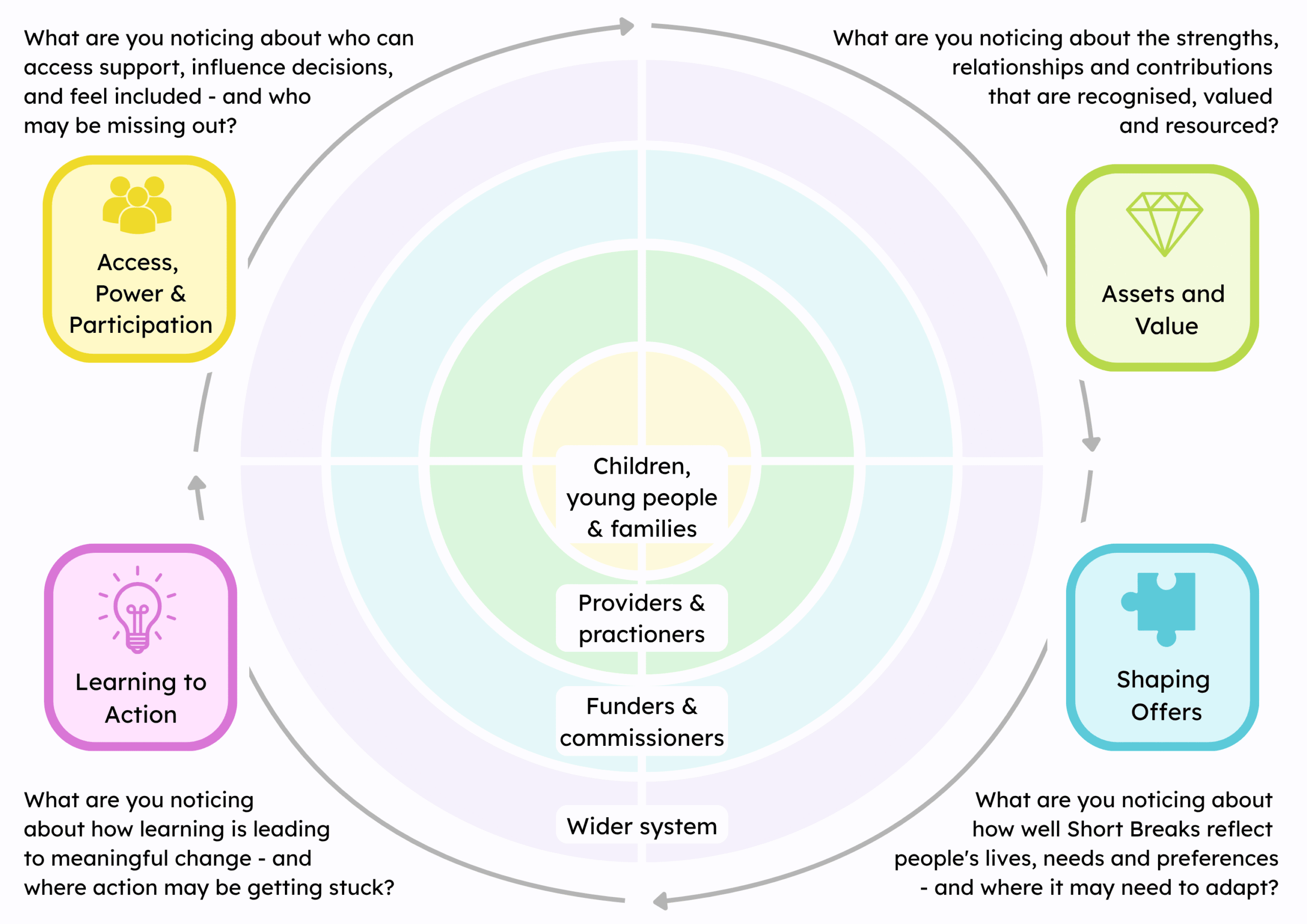
What are we noticing about what’s helping people feel included, find support, or have a say in how things work?
A key enabler of access was the programme’s full refund policy, which greatly reduced financial risk for families managing uncertainty around their child’s needs, regulation, or day‑to‐day wellbeing. This flexibility allowed parents to book sessions without fear of losing money should their child struggle to attend at short notice.
Provider
- Co-production with parent-carers is desirable but challenging, due to time/pressure; feedback needs to be lightweight and relationship-based, with parent-carer and young people’s voice shaping provision continuously.
- Co-design that is relationship-based (ongoing conversations, sessions shaped in real time), with multiple low-effort feedback routes rather than relying on surveys alone.
- First-time access/anxiety reduces when onboarding is proactive (pre-booking calls, clear pre-event info/PECS, predictable routines, consistent staff) and when delivery stays flexible and child-led.
- Predictable routines, consistent staff and SEND-aware, sensory-friendly environments, with flexible pacing and 1:1 support when needed.
- Trauma-informed, unhurried practice that prioritises time, trust and flexibility—especially for families previously excluded or facing cultural/mistrust barriers.
- Financial and practical barriers matter: affordable pricing with refunds/subsidies to remove financial risk, full refunds, and transport support are critical enablers—especially for rural and poorer families.
But…
- Significant gaps remain for complex needs: relational, low-demand and co-regulated support (not just activity-based breaks), plus trust-building over time; workforce recruitment/retention and specialist training costs are ongoing constraints.
- Accessibility and infrastructure are limiting factors (e.g., need for Changing Places/sensory facilities, hoists, and purpose-built spaces); many short break budgets are ‘unusable’ without providers able to deliver safely.
- Addressing hidden exclusion—particularly for children with medical needs—by ensuring provision can safely meet routine care requirements.
What are we noticing about what’s being recognised, supported or resourced — in terms of strengths, relationships or contributions?
It needs to be recognised that ‘value for money’ can’t be measured on a price per head basis. It’s extremely difficult to measure what has NOT happened as a result of the Short Breaks funding and therefore the inherent cost savings generated. e.g. less referrals for anxiety support, more children able to attend school, more parents and carers able to work.
Provider
- Flexible funding enables access: Short Breaks test and learn funding supports specialist ratios, adaptive resources and safe delivery; affordability measures (subsidies and full refunds) reduce financial risk for families.
- Strengths in workforce and relationships: using skilled staff who know and understand their young people, supporting professional growth and safer staffing ratios; valuing trusted, relational practice (Short Breaks must be relational, not transactional).
- True value beyond cost-per-head: benefits include prevention/avoided escalation, fewer referrals, improved attendance and enabling parent‑carers to work; specialist skills and higher ratios drive costs.
- Inclusive workplace culture and lived‑experience leadership: neurodivergent/autistic staff supported to be authentic, progress into roles and become role models; neuro‑affirmative practice spreading into other settings.
But…
- Infrastructure & sustainability: baseline costs include booking/payment systems, websites, training, equipment, venues and insurance; layered grants/shared costs help short-term but long-term models need full cost recovery.
- Admin/onboarding and safeguarding workload is far higher than funding models assume—commissioning needs realistic costing, dedicated staffing, flexible grants, and sustained investment in specialist training.
What are we noticing that’s helping services or systems respond well to people’s needs, preferences or circumstances?
The project also generated key insights for the redesign of Short Breaks commissioning in Gloucestershire. Administrative and onboarding work was significantly more time‑intensive than expected, highlighting the need for realistic costing and dedicated staffing. The importance of transport, flexible funding, and investment in specialist training was reinforced throughout delivery.
Provider
- Personalisation is the number one enabler of access according to COP members. Disabled children and families are all different, and Short Breaks work best when they are tailored, personalised and flexed around the individual and their family.
- Provision must adapt to age/need (e.g. teen-appropriate venues/activities) and to fluctuating regulation, often requiring higher staffing ratios and personalised 1:1 support.
- Flexible funding without over-specified outputs and KPI’s allows for continuous adaptation and tailoring to groups and individuals, increasing the likelihood of positive outcomes and value for money.
- Specialist training widens inclusion: ongoing SEN/disability, communication, behaviour/sensory, medical and safeguarding training enables participation for more complex needs.
- Creating alternative, low‑pressure ways to connect (e.g., at‑home ‘Being Us’ newspaper) for young people unable to attend due to anxiety.
- Using consultation and ongoing communication (incl. parent steering groups) plus professional input and pilot sessions to refine provision.
- Partnering with trusted organisations/schools and community hubs to improve venue suitability, staffing and reach.
- Reducing barriers by meeting families where they are (home/familiar spaces), prioritising relationship‑building before attendance, and flexing transport to what’s realistic.
- Treating families as experts—co‑designing offers that provide either separate activities or supported connection depending on need.
What are we noticing that’s helping people or organisations reflect, learn, or make meaningful changes?
With increased visibility […] we’ve been approached for conversations to develop new work and partnerships. Through these partnerships, we’re able to share what we’re learning, so our neuroaffirmative practice can ripple way beyond the clubs.
Provider
- Identifying emerging needs through delivery (e.g. supporting autistic young people with transition to secondary school).
- Adapting delivery based on prior learning — moving away from standardised venues/transport assumptions towards flexible, responsive, ‘meet families where they are’ approaches.
- Testing, learning and iterating offers rather than dropping them: e.g. trialling different drama formats, then shifting to more accessible comedy/immersive approaches and co-delivering with inclusive partners.
- Using pilots and partnerships to improve inclusion (e.g., working with Birdland to create social stories that help families prepare and feel confident).
- Building future strands from learning (e.g. exploring online/remote options for families facing extreme anxiety or transport barriers, fundraising for an accessible venue).
Transferable lessons
This blog provides a taster of the important work and the rich learning which is being generated through the test and learn fund and the Community of Practice. In some ways the learning is very specific to the provision of Short Breaks – inclusive and accessible activities for young people who cannot access mainstream provision.
In other ways, the findings are familiar and applicable across many of our public services. These can be summed up as:
- Relationships and personalisation matter the most.
- Flexible, relational funding with an expectation of adaptation is the key to value for money.
- Early help situated within communities with fewer barriers to access prevents crises and a lifetime of exclusion.
- Collaboration across a system is critical to helping people find the help they need.
- Structural barriers (workforce, transport, accessible venues) must be taken seriously and addressed if people are to be able to access the help they need.
- When commissioners and funders spend time learning with providers, they are more likely to be able to design services and funding programmes that make the most of the resources they have.
Being part of the Community of Practice is a highly valuable shared learning space where trust grows, relationships form and new potential is sown. This takes time and careful facilitation makes this possible, without being outcome focussed. Funding organisations to be able to confidently attend is essential. Being part of a group who meet regularly enables some really important things to happen
Provider
We publish this blog at a key moment in the Short Breaks work. We are halfway through the two-year T&L fund, and in the middle of the recommissioning process. It has been extremely positive to see GCC commissioners learning along with us from the T&L work and working closely with partners to propose a new model for commissioning Short Breaks from 2027. Despite the limitations of budgets, statutory requirements and structural barriers that are hard to remove, there is genuine hope that 2027 will see a Short Breaks offer that is genuinely more accessible, inclusive and preventative than what has gone before in Gloucestershire, so that ‘so that families of disabled children and young people have a voice and choice in the services that exist for them.’
We are sharing this work beyond the partnership because we hope there are useful lessons from the work beyond Short Breaks and Gloucestershire. We would love to hear from other places and other services who are grappling with similar questions and seeking to change the way they commission and provide support and services in ways that are more relational, adaptive and collaborative – and better value for money.
With thanks to our wonderful CoP members:
Belmont School
Can’t Sit Still
Creative Sustainability
Move More
Music Works
ND Hub
Parent Carer Alliance
Spring Centre
Active Gloucestershire
Active Impact
Allsorts
Forest Pulse